
Digital eXperience · Employee eXperience · Customer eXperience · Business Growth
The Invisible Tax on Enterprise Growth: Quantifying the Friction Between DX, EX, and CX
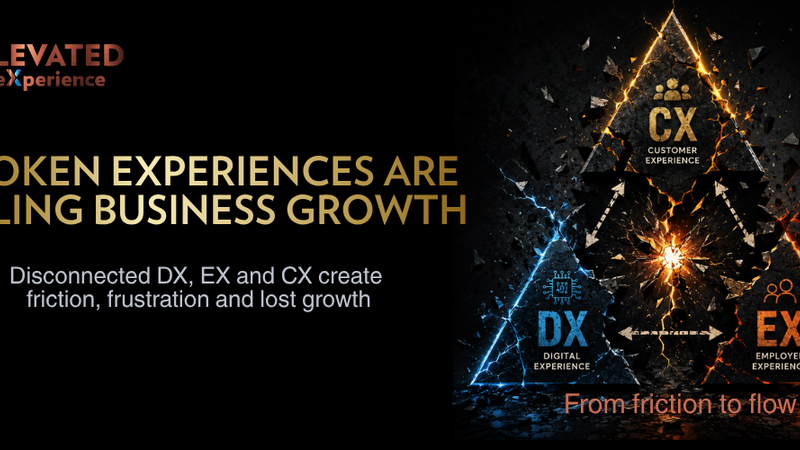
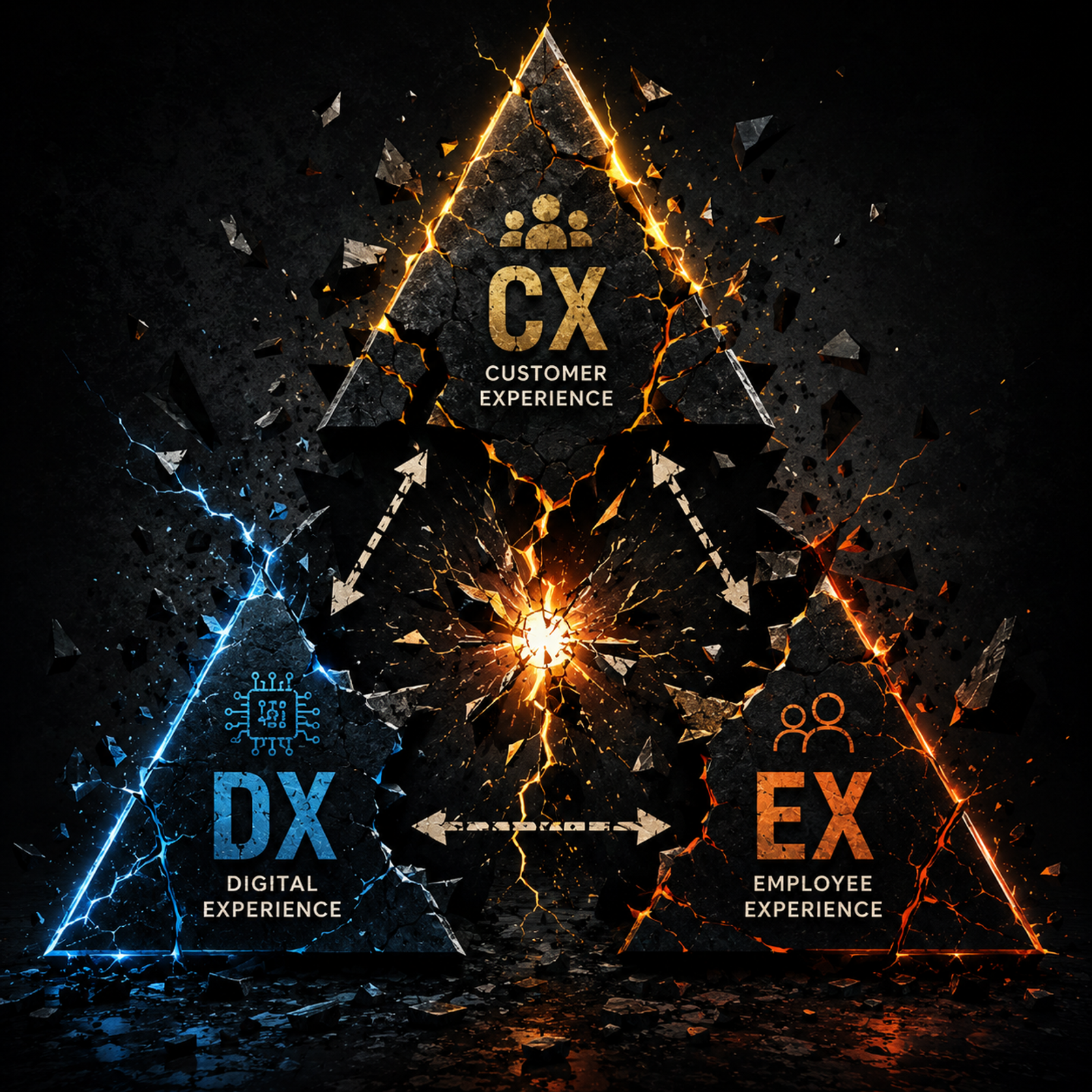
Organisations are sub-optimising their growth through a systemic failure to connect three fundamental pillars of business operations: Digital Experience (DX), Employee Experience (EX), and Customer Experience (CX).
Executive Summary
In the modern corporate landscape, organisations are sub-optimising their growth through a systemic failure to connect three fundamental pillars of business operations: Digital Experience (DX), Employee Experience (EX), and Customer Experience (CX). Historically, enterprise structures have treated these domains as isolated specialisations, governed by separate budget holders, disconnected software applications, and distinct departmental strategies.
The friction generated at the intersection of these isolated domains acts as an invisible tax on enterprise performance. Recent global operational data demonstrates that data silos and fragmented technology environments cost mid-sized to large organisations between 20% and 30% of their annual revenue in lost productivity, delayed decision-making, and fractured customer journeys.
This whitepaper details the empirical financial costs of operational friction across the enterprise ecosystem. It establishes the direct, cascading relationship between technology architecture, staff engagement, and market retention, and introduces The S.H.I.N.E. Blueprint™, a structured methodology designed to eliminate institutional friction, align cross-functional leadership, and restore strategic flow.
The Core Friction Triad: DX, EX, and CX
Enterprise performance is dictated by the weakest link in the operational chain connecting systems, staff, and clients. When these interfaces fail to communicate, friction escalates rapidly.
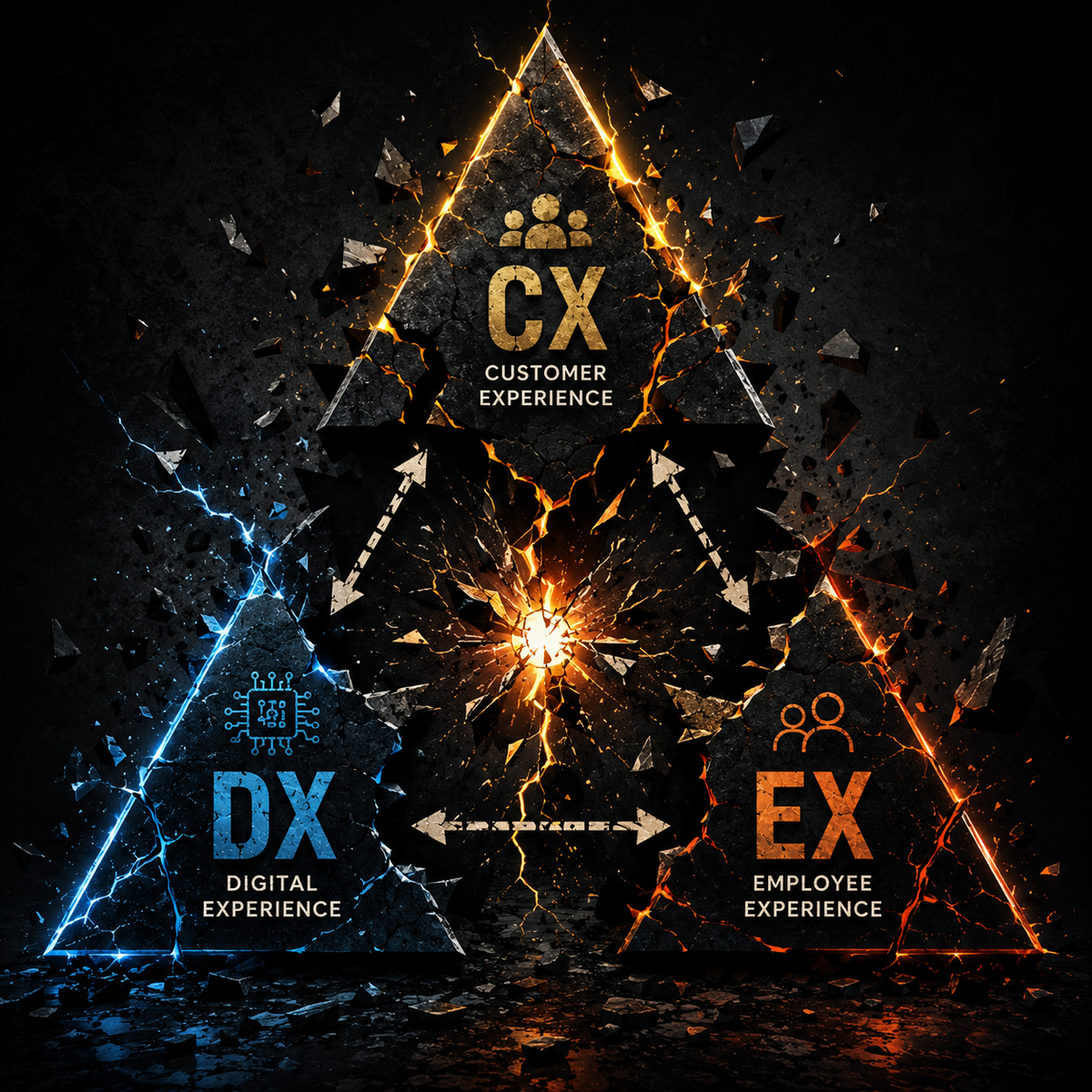
1. The Technology-to-Employee Interface (DX to EX)
When an organisation deploys complex enterprise software without assessing the daily operational context of the frontline workforce, the employee experience degrades instantly. Corporate digital environments have grown increasingly complex, with research showing that enterprise workers use an average of nearly three separate applications to complete a single task, and over half must regularly toggle between distinct systems just to complete one workflow.
The modern employee loses an average of 7.9 hours per week to digital friction. This operational drag is caused by a lack of context-aware software support, cross-app fragmentation, and poorly integrated automation tools. Cumulatively, this friction robs every single worker of 51 productive working days per calendar year, driving widespread staff frustration and disengagement.
2. The Employee-to-Customer Interface (EX to CX)
A compromised internal employee experience invariably compromises the external customer experience. True alignment requires a deep cultural buy-in across the workforce, as staff are ultimately responsible for capturing data and executing service delivery.
Data compiled by Qualtrics indicates that engaged workforces yield 21% higher corporate profitability and 17% higher baseline productivity. Crucially, 70% of highly engaged workers demonstrate a thorough understanding of how to meet customer demands, whereas a mere 17% of disengaged workers can state the same. Brands that maintain high internal employee engagement scores achieve a 24% increase in Net Promoter Scores (NPS) and a 12% rise in active customer advocacy compared to less engaged market competitors. Conversely, technology gaps that frustrate personnel lead straight to broken customer touchpoints and immediate client churn.
3. The Customer-to-Technology Interface (CX to DX)
When backend databases do not connect with consumer-facing digital channels, customer relationships fracture. Typical corporate environments leave customer relation management systems completely isolated from core enterprise resource planning architectures. This leads to major gaps in visibility, where a client management database may display an account as active and highly engaged while an isolated financial accounting ledger shows the exact same account as sixty days past due.
This total lack of system coordination results in conflicting operational strategies, slower resolution times, and fractured service delivery that damages corporate reputation and erodes market share.
The Empirical Cost of Isolation
The Productivity Drain
The immediate operational penalty of departmental isolation is the significant amount of corporate time wasted locating essential information. Research shows that employees waste up to 12 hours every week searching for data trapped across disconnected enterprise applications. This means that nearly 30% of the standard corporate workweek is entirely consumed by the administrative burden of navigating a fragmented data landscape. For a standard mid-sized enterprise, this productivity drain can account for thousands of lost hours every single month, which is the equivalent of losing several full-time personnel purely to technological inefficiencies.
The Revenue Loss
On a macro economic scale, the financial implications of information isolation are severe. It is estimated that Fortune 500 corporations lose a combined 31.5 billion dollars annually due to knowledge silos and a systematic failure to share operational context across teams. This loss surfaces as duplicated internal projects, conflicting departmental strategies, missed cross-selling opportunities, and the complete destruction of institutional knowledge when frustrated workers leave the firm.
The Visibility Gap
The underlying catalyst for this commercial loss is a massive visibility blind spot between executive leadership and frontline teams. Global studies reveal a striking disconnect in corporate awareness: corporate executives estimated that their teams were running roughly 35 software applications enterprise-wide, whereas actual operational audits observed over 660 active applications across the exact same firms. This extraordinary visibility gap makes it nearly impossible for chief digital officers and operations leaders to reduce friction, as they possess an entirely unrealistic picture of the complex software environment their employees are forced to navigate every single day.
Why Traditional Transformations Fall Flat
The reason corporate change initiatives fail is that organisations consistently view transformation as a pure technology procurement project rather than a human and system alignment journey.
When a firm decides to upgrade its infrastructure, leadership typically engages a technical provider focused purely on code deployment and software setup. The digital experience is driven exclusively by an IT manager, employee culture is left entirely to a human resources team, and the customer experience is managed in complete isolation by a client service team.
These core leaders possess completely separate financial budgets, follow entirely separate corporate strategies, and operate with separate motives. Because these isolated departments fail to collaborate, internal politics take over, data becomes trapped within separate tools, and adoption rates collapse. True operational flow can only happen when the digital architecture is intentionally structured to support the human workflows of the people using it daily.
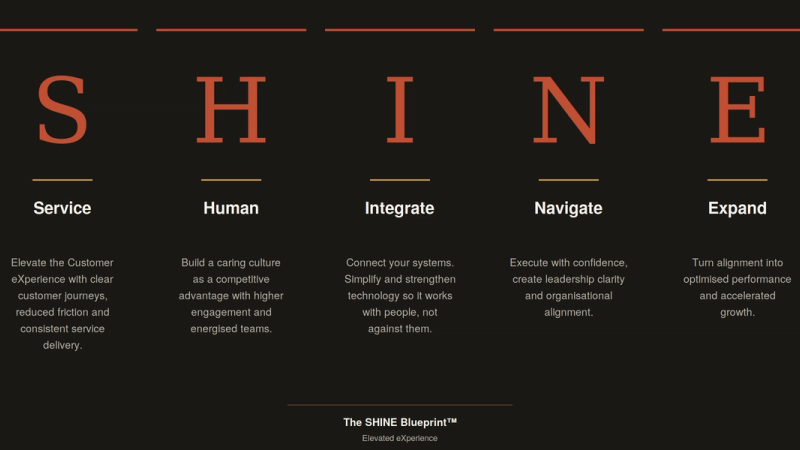
The Solution: The S.H.I.N.E. Blueprint™
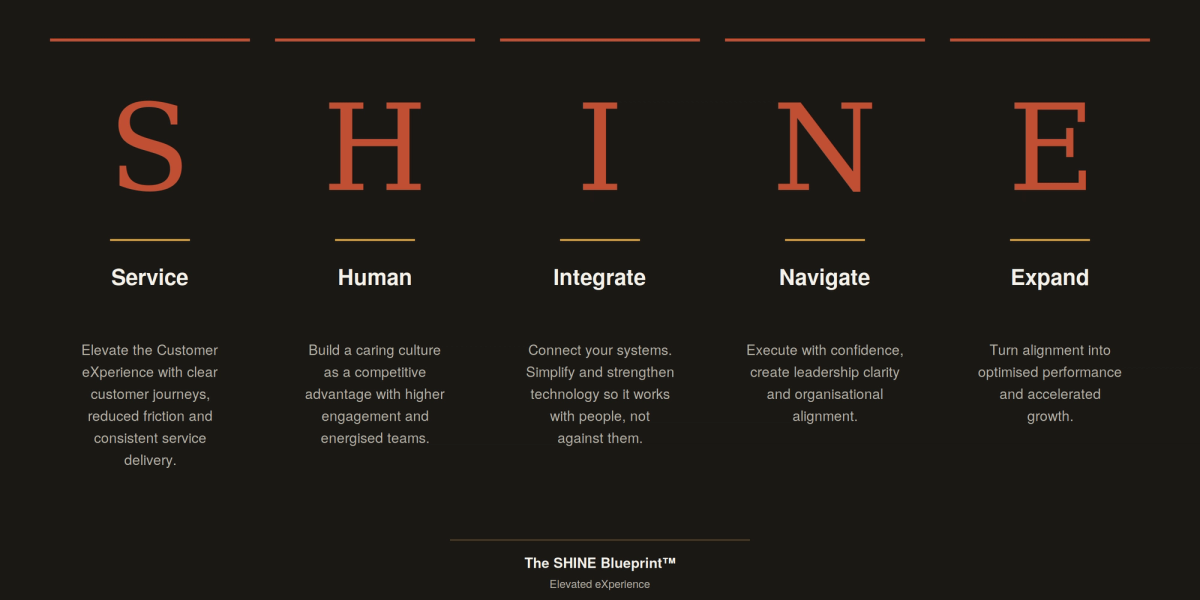
To eliminate the institutional friction that erodes enterprise revenue, organisations must shift away from fragmented adjustments and move toward a unified, cross-functional operating model. The S.H.I.N.E. Blueprint™ provides a structured, five-stage methodology designed to dismantle corporate silos, align department budgets, and connect technology directly with human empathy.
1. Service (S)
The blueprint begins by elevating the Customer eXperience through the mapping of clear, intentional customer journeys. By identifying and eliminating the transactional roadblocks that irritate buyers, organisations can reduce friction and secure highly consistent, predictable service delivery across every single touchpoint.
2. Human (H)
True transformation requires an active focus on the workforce executing the strategy. This stage is dedicated to building a deeply caring internal culture, transforming employee experience into a core competitive advantage. Higher staff engagement, open psychological safety, and energised teams ensure that personnel actively advocate for corporate goals rather than resisting changes.
3. Integrate (I)
During this phase, technical teams break down the operational and financial barriers that isolate critical business applications. Core technology infrastructures are simplified and strengthened, connecting your systems natively so that software actively works with your people, not against them.
4. Navigate (N)
Execution requires absolute directional clarity. This stage removes the strategic fog by establishing clear cross-functional alignment and defining precise milestones for leadership teams. By providing structured, transparent roadmaps, organisations can execute operational changes with total executive confidence and zero structural ambiguity.
5. Expand (E)
The final phase focuses on turning deep internal alignment into optimised market performance and accelerated commercial growth. With structural friction eradicated and workflows tightly unified, the enterprise successfully transitions into a state of continuous operational flow, maximising existing assets and rapidly scaling global profitability.
Conclusion
Operating with separate strategies, isolated budget holders, and fragmented digital tools is a direct threat to corporate profitability and workforce retention. Technology can no longer operate independently from employee culture and customer care.
The S.H.I.N.E. Blueprint™ offers a practical, field-tested roadmap to eliminate these hidden operational costs for good. By systematically connecting digital infrastructure with human empathy, modern enterprises can successfully escape the invisible tax of corporate silos, unlock the full value of their technology investments, and position their organisations to scale successfully in a highly competitive global marketplace.